
Gold plated jewellery gets a bad reputation it doesn’t always deserve. Most of the time, when a bangle or a pair of earrings starts looking dull after a few months, it isn’t a sign of cheap workmanship. It’s a sign of how the piece was worn, stored or cleaned. A thin layer of 24k gold sits on top of a base metal, and that layer is what gives the piece its glow but it’s also thin enough that everyday habits can wear it down faster than they should.
If you’ve bought 24k gold-plated jewellery and want it to keep its finish for years rather than months, the good news is that most of the damage is preventable. None of it requires anything fancy. It just means understanding what actually attacks the plating and building a few habits around that.
Why gold plating fades in the first place
Gold-plated jewellery is made by depositing a microscopically thin layer of real gold onto a base metal, usually brass or silver. That layer gives you the look of solid gold at a fraction of the cost, but it’s measured in microns, not millimetres. Compare that to solid gold, where the shine goes all the way through, and it’s easy to see why plated pieces need a different kind of attention.
Three things wear that layer down over time: friction, chemicals and moisture. Friction happens every time a bracelet rubs against a desk or a ring catches on fabric. Chemicals come from perfume, lotion, sweat and cleaning products. Moisture speeds up tarnishing on the base metal underneath, which then shows through the gold as discolouration. None of these are dramatic events on their own it’s the accumulation that dulls a piece.
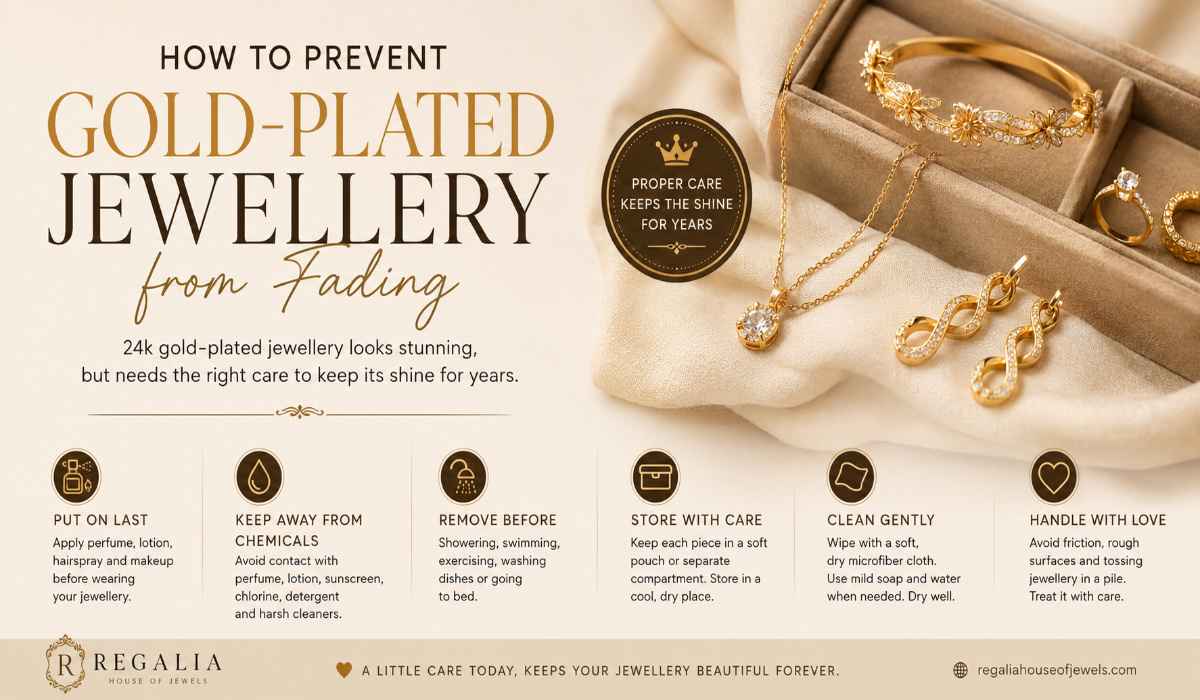
Put jewellery on last, take it off first
This is the single habit that makes the biggest difference, and it costs nothing. Perfume, hairspray and deodorant all contain alcohol or chemical compounds that react with gold plating, so get dressed and finish your routine before you put your jewellery on. At the end of the day, reverse the order: rings and bracelets come off before you wash your hands or apply night cream, not after.
The same logic applies to swimming pools, showers and the gym. Chlorine is particularly harsh on plated metal, and sweat carries salts that speed up tarnishing. A quick habit of taking rings off before a workout will add months, sometimes years, to how long the gold layer holds up.
Store pieces so they can’t rub against each other
A lot of fading actually happens in the jewellery box, not on your skin. When pieces are tossed together in one drawer or pouch, they scratch each other every time you dig through them, and each scratch is a tiny bit of gold worn away.
A few habits help here:
- Keep each piece in its own soft pouch or a lined compartment, rather than piled loosely.
- Store jewellery somewhere dry a bathroom cabinet, which gets humid every time you shower, is one of the worst places for it.
- Keep pieces away from direct sunlight for long stretches, since heat and light both accelerate tarnishing on the base metal.
If you bought a set say, a necklace with matching earrings storing them together in their original box is usually fine, since they were packed that way to avoid contact in the first place. The point is not to leave them loose with other jewellery so they collide.
Cleaning without stripping the gold
This is where a lot of accidental damage happens. Ultrasonic cleaners, jewellery dips and anything abrasive are designed for solid gold or silver, and they’re too aggressive for a thin plated layer. A few passes through an ultrasonic cleaner can strip plating that took years to wear down naturally.
For everyday cleaning, a soft, dry microfiber cloth is enough to bring the shine back after a light layer of dust or oil builds up. If a piece genuinely needs washing, lukewarm water with a drop of mild soap works, followed by immediate, thorough drying don’t let it air dry, since sitting damp is worse than the wash itself. Avoid baking soda, toothpaste and vinegar; they’re common home remedies for tarnished silver, but they’re too harsh for gold plating and will wear it down faster, not slower.
Know which activities to take it off for
Some situations are worth a quick pause to remove jewellery, even if it feels like a hassle in the moment:
- Washing dishes or cleaning the house, since most household cleaners are chemically harsh
- Applying sunscreen or lotion directly to skin where a ring or bracelet sits
- Swimming, whether in a chlorinated pool or the sea
- Sleeping, since friction against sheets and pillows adds up over a night’s worth of movement
- Heavy exercise or manual work where sweat and friction combine
None of this means gold-plated pieces are fragile in daily life. It just means treating them the way you’d treat a good pair of shoes fine for regular wear, but not for the shower.
What to do once the plating starts wearing
Even with careful use, plating eventually thins with enough years of wear, and that’s normal rather than a defect. The first sign is usually a slight colour shift at points of high contact, like the inside of a ring band or the back of an earring post. At that stage, cutting back on how often the piece touches skin or fabric wearing it for occasions rather than daily is usually enough to slow things down further.
If a piece has genuinely lost its finish, replating is possible for well-made pieces with a solid base metal, and it’s worth asking a jeweller before assuming a piece is done for.
Building a routine that actually sticks
Care habits only work if they’re easy to keep up, so keep it simple: jewellery goes on last and comes off first, pieces get their own space in storage, and cleaning stays limited to a soft cloth and the occasional mild soap wash. That’s really the whole system.
If you’re building out a collection and want pieces that are easy to care for from the start, our earrings, necklace and bangle collections are all finished in 24k gold plating with the same craftsmanship in mind. For anything you’re unsure about, from styling to specific pieces, our FAQs page covers common questions, and you can always reach out directly if you’d like advice on a specific piece.
